Texas A&M AgriLife Cotton Study: Sulfur-Burner-Treated Irrigation Reduced Root-Zone Salinity and Increased Yield 20%
Contents
Contents
Far West Texas cotton has a water problem that isn’t subtle: salinity builds, sodium builds, infiltration drops, and yield follows.
Most growers hear “salinity” and think, “That’s a salts-in-the-water issue — not a pH/bicarbonate issue.”
Texas A&M AgriLife’s field work in Far West Texas is a useful reality check: acidified irrigation water (via a sulfur burner) was evaluated specifically for salinity + sodicity management in an irrigated cotton field — and the first-year results were meaningful. [1]
This post unpacks what they found, why it can work (in the right soil chemistry), and how to tell if this is worth evaluating on your farm.
TL;DR (60-second version)
- Texas A&M AgriLife evaluated sulfur burner–treated, blended irrigation water in a Far West Texas cotton field with elevated salinity and sodicity. [1]
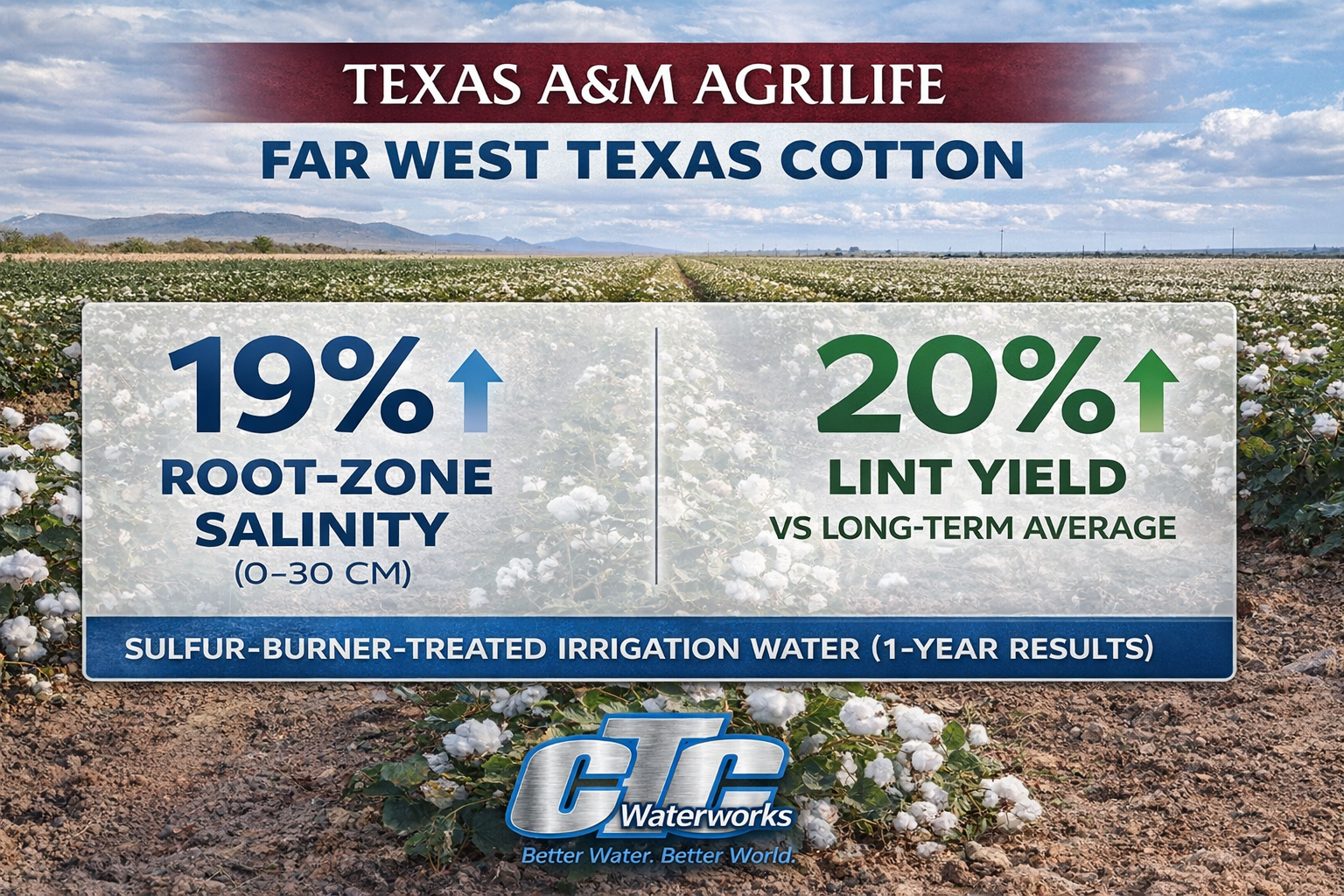
- After one year, the site showed a 19% reduction in salinity in the top 0–30 cm, plus improved SAR patterns (with some sodium redistribution by depth). [1]
- The field’s cotton lint yield increased ~20% vs the long-term average, and fiber quality improved — but one season was not enough to bring worst-case salinity/SAR below thresholds everywhere. [1]
- The “why” is not magic: acidification can solubilize native calcium (calcite/gypsum) in calcareous soils, helping calcium displace sodium on exchange sites, improving soil structure/permeability so salts can be leached below the root zone with adequate water management. [2]
- This is not “a salinity cure in a box.” It’s a chemistry lever that can help when (1) soils are calcareous, (2) sodicity is degrading infiltration, and (3) you can actually leach salts. Multi-year confirmation matters. [1]
What Texas A&M measured (and what changed after one season)
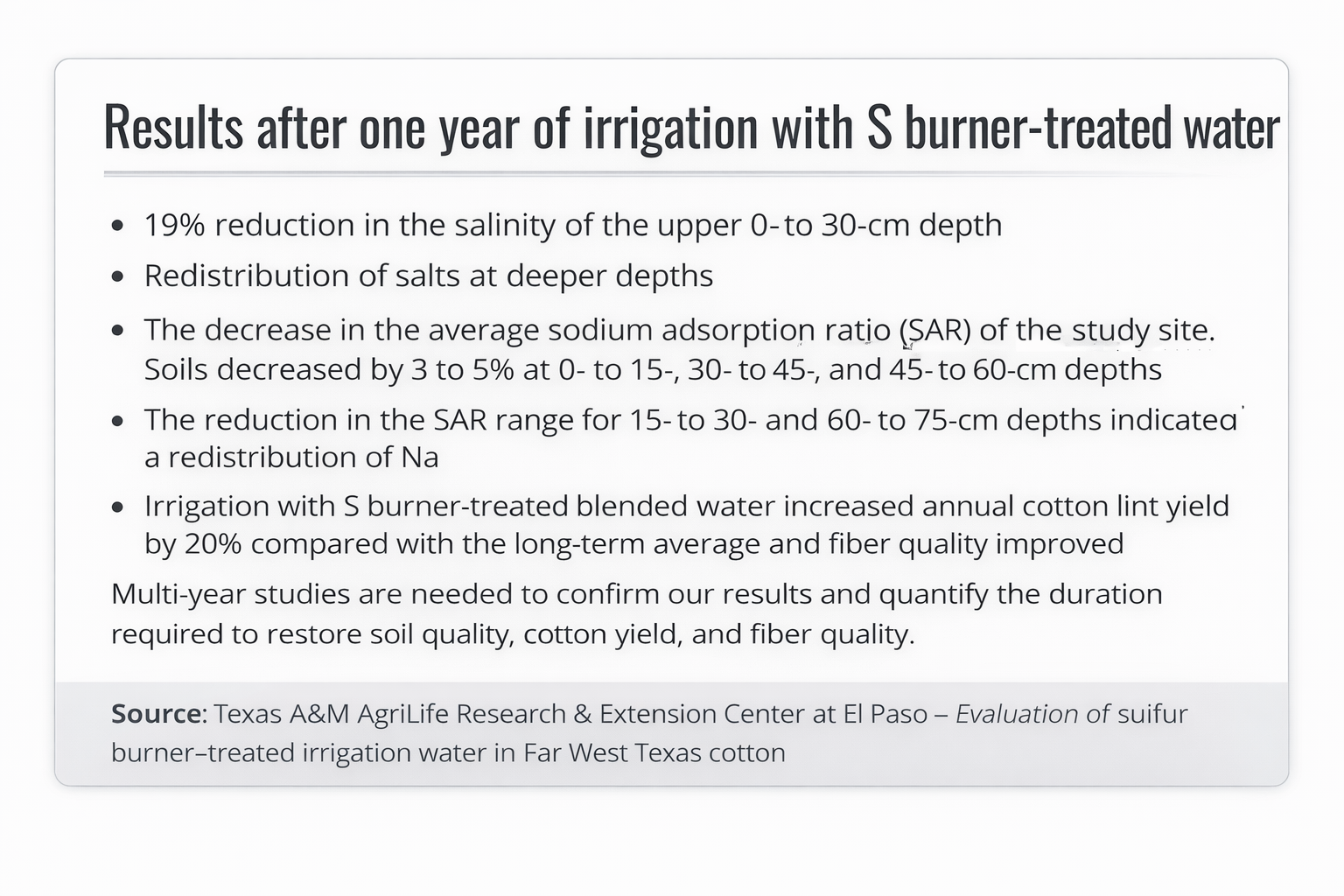
Texas A&M AgriLife’s El Paso center summarized a field evaluation in a 9.2-ha irrigated cotton site with salinity + sodicity problems. [1]
Key first-year outcomes they reported:
- 19% reduction in soil salinity in the upper 0–30 cm depth. [1]
- Salt redistribution at deeper depths (important: that can be “good” leaching, or it can be “moved, not solved,” depending on drainage/leaching conditions). [1]
- SAR decreased by about 3–5% at multiple depths (0–15, 30–45, 45–60 cm), with some redistribution patterns at other depths. [1]
- Cotton lint yield increased ~20% compared with the long-term average and fiber quality improved. [1]
- Caveat: one year did not reduce maximum salinity and SAR below threshold levels at different depths. They explicitly call for multi-year work to quantify how long restoration takes. [1]
Salinity vs sodicity vs SAR
These terms get mixed up, but they drive different failure modes in the field:
- Salinity is “how much dissolved salt is in the soil solution.” Too high, and plants struggle to pull water (osmotic stress).
- Sodicity is “how much sodium is on the soil’s exchange complex.” Too high, and soil structure can collapse: infiltration slows, crusting increases, permeability drops.
- SAR (Sodium Adsorption Ratio) is a practical indicator tied to sodicity risk — it reflects the balance of sodium relative to calcium and magnesium.
Why it matters: you can sometimes have “salinity” and still irrigate your way through it — until sodicity wrecks infiltration. Once infiltration drops, you can’t leach salts effectively, so the problem compounds.
This Texas A&M work matters because it is aimed at that compounding loop.
Why acidified irrigation can help in calcareous soils
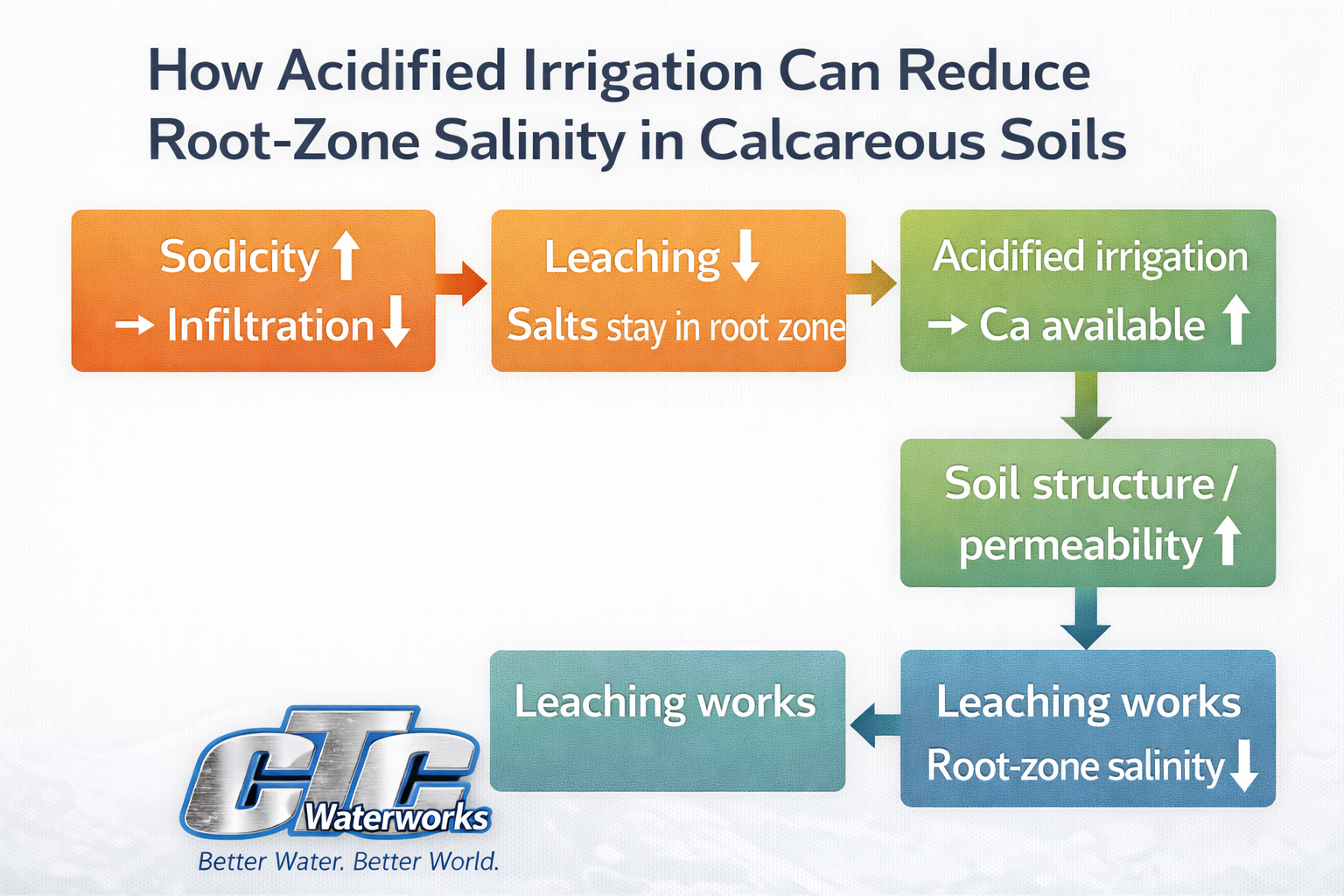
The project fact sheet describes the core hypothesis in practical agronomy terms:
- Use acidification to solubilize native calcium sources in the soil (calcite and gypsum in calcareous systems). [2]
- That calcium can counter sodium on exchange sites, improving aggregation/permeability. [2]
- Once permeability improves, excess water can move salts below the effective root zone (when drainage/leaching conditions exist). [2]
In other words: acidification is not “removing salts from the farm.” It’s improving the chemistry/structure so you can actually move salts.
This is also why two fields can try the “same” approach and get very different outcomes:
- Field A: calcareous soil + sodium-driven infiltration issues + ability to leach → more responsive.
- Field B: limited drainage, shallow restrictive layer, or no leaching fraction → less responsive.
What this does NOT mean
To keep this grounded, here are the common misreads of studies like this:
1) It doesn’t mean a sulfur burner “solves salinity” universally.
It’s a tool that can improve the conditions needed for leaching and reclamation — especially where sodicity is part of the failure mode. [1] [2]
2) It doesn’t mean the job is done in one season.
Texas A&M explicitly notes that even with improvements, worst-case salinity/SAR were still above thresholds in places after year one. [1]
3) It doesn’t replace water management.
If you cannot create meaningful downward movement of water through the profile (or you have nowhere for drainage to go), “redistribution” can become “relocation.”
Decision guide: is this worth evaluating on your farm?
This is the fast “self-qualify” checklist.
1) Soil signals (field symptoms)
- Infiltration declining over time (same set time, less water intake)
- Surface sealing/crusting, hard-setting beds
- Patchy growth tied to soil zones
- Salinity patterns that persist even with “enough water applied”
2) Tests to pull
- Soil salinity profile by depth (not just one shallow sample)
- SAR / sodicity indicators by depth
- Basic water chemistry (pH + alkalinity/bicarbonates) plus sodium and hardness balance
If you don’t have depth resolution, you’re guessing.
3) Chemistry/soil context that tends to matter
- Calcareous soil indicators (free lime / carbonate presence)
- Evidence of sodium-driven structure problems (not just “salts high”)
Texas A&M’s fact sheet explicitly frames the mechanism around native Ca sources in calcareous soils. [2]
Practical implementation notes
If you’re evaluating acidified irrigation for a salinity/sodicity program, the operator mindset should be:
- Treat it like a multi-season soil improvement program, not a one-time fix. [1]
- Track progress by depth (salinity + SAR patterns), not by a single surface number. [1]
- Watch for the “redistribution” issue: salts moving deeper is often the goal — but only if they keep moving out of the effective root zone and don’t rebound.
And if you want this to be a serious program (not a hope-and-pray purchase), you need:
- baseline sampling,
- a target outcome definition (what “better” means in your field),
- and a monitoring cadence.
That’s where verification and documentation matter.
Frequently asked questions
“Is this only for cotton?”
No — the mechanism (sodium displacement + permeability + leaching) is not cotton-specific. But cotton is a helpful case because it’s widely grown in the West Texas region and salinity pressure is real.
“What do we do next?”
If this sounds like your operation, the best next step is not a quote — it’s a quick technical review with our team:
- your water report,
- your soil salinity/sodicity profile (by depth),
- and your irrigation/leaching reality.
If the chemistry + field constraints fit, then it’s worth running numbers and designing a monitored plan.
References
Found this helpful? Let's discuss it!
Share your thoughts and experiences on LinkedIn